Sunday Health Newsletter - Triglycerides
Sunday July 31st, 2022

High triglycerides may contribute to hardening of the arteries or thickening of the artery walls (arteriosclerosis) — which increases the risk of stroke, heart attack and heart disease.
High triglycerides are often a sign of other conditions that increase the risk of heart disease and stroke, including obesity and metabolic syndrome.
- Mayo Clinic Website[1]
DISCLAIMER: David Beruh (Grand Strand Health Coaching) is an American Council of Exercise (ACE) Certified Health Coach and National Association of Sports Medicine (NASM) Certified Personal Trainer.
The information in this newsletter is for educational purposes only. It is not intended nor implied to be a substitute for professional medical advice. You should always consult your health care provider to determine the suitability of the information presented or if you have questions about a medical condition, treatment, or lifestyle change.
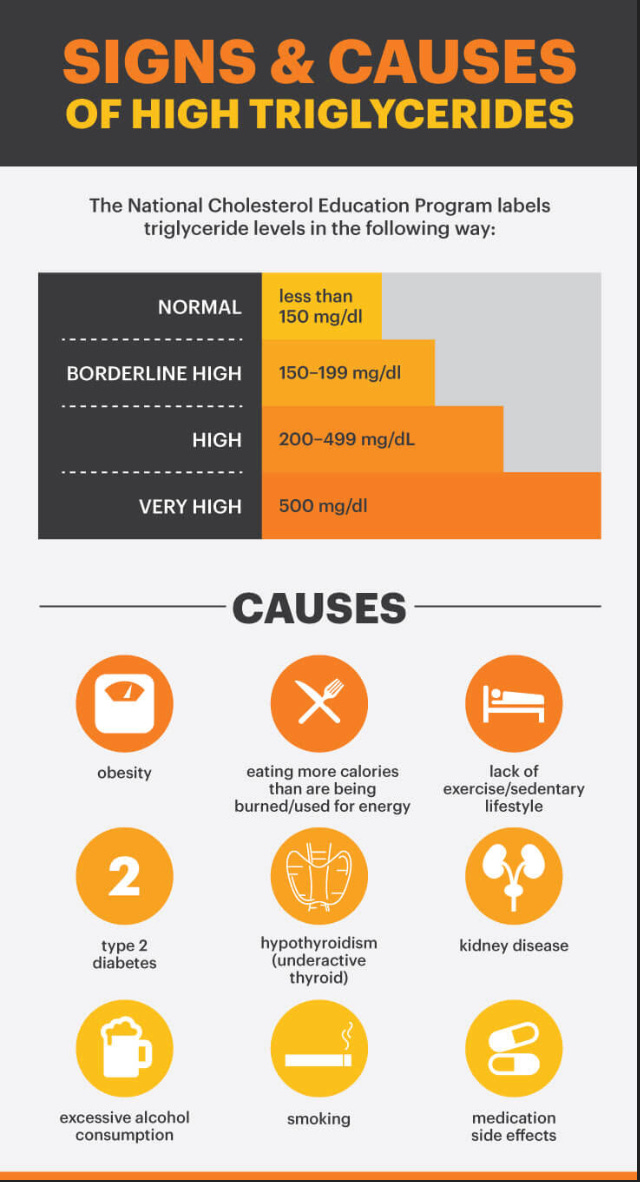
Triglycerides are the most common form of fat circulating in the blood. High triglyceride levels are one symptom of insulin resistance and Metabolic Syndrome. Readings of over 150 mg/dl are considered high although under 100 mg/dl is a better number to shoot for.
“I always look at the triglycerides first. And if they are under 100 and closer to 50, then I’m happy with that. More than anything, I look at the triglyceride to HDL ratio with an optimal goal to be as close to 1 or lower.
- Cassie Bjork, Registered Dietician (RD)[2]
A Triglyceride to HDL Cholesterol of 2:1 ratio is considered healthy although a 1:1 ratio is a better indicator of health. Triglycerides and HDL are measured in a standard Lipid Panel blood test along with Total Cholesterol and LDL.
“There isn’t a drug that lowers triglyceride levels well, which is why mainstream medical doctors don’t pay much attention to them. But triglycerides respond very well to dietary changes.”
- Paul Jaminet, author of the Perfect Health Diet[3]
One way to lower your triglycerides is through a low carbohydrate diet[4]. Low carbohydrate can be defined in many ways but typically it is anything below 150 grams of carbohydrate (or around 30% of caloric intake) daily.
This creates another problem for the medical establishment that has generally looked down on low carb diets as being too high in fat and thus unhealthy. In 1974 the American Medical Association was so concerned about the Atkins diet it endorsed an attack on Dr. Atkins and his diet in the Journal of the American Medical Association.[5]
I’m not going to discuss the pros and cons of a low carb diet or Dr. Atkins here, only to note his book sold 20 million copies, is still in print and was updated in 2010 by Eric Westman, MD of Duke, Jeff Volek, PhD, RD of Ohio State and Stephen Phinney, MD co-founder of Virta Health, and Professor of Medicine Emeritus at University of California, Davis.[6]
Low carbohydrate diets are almost by definition high fat. There are only three macronutrients: Protein, Carbohydrates and Fat. The average American is reported to eat a diet of 50% Carbohydrates, 15% Protein and 35% fat. [7] The maximum protein recommendation by the USDA is 35%, so while there is room to increase protein, a large part of carbohydrate restriction comes from eating more fat.
Increasing the fat in your diet should not be feared. It is uncontroversial to say if you are overweight, losing weight is healthy. The CDC says, “Even modest weight loss can mean big benefits.”[8] But whenever we lose weight, we are by definition on a higher fat diet. We are not eating it but rather burning the fat stores on our body for sustenance.
One important note on the triglyceride to HDL ratio, it should not be used as measure in African Americans, who can develop insulin resistance with normal triglyceride levels.[9]
For those with high triglyceride levels that don’t want to or can’t adhere to a low carb diet, dietary fiber has also been found to be helpful as has exercise; in particular, high intensity exercise[10].
So, at the very least to lower high triglyceride levels, which do present a clear risk to your health, you should eat a more nutrient dense diet, rich in natural fiber and get more exercise. Easier said than done of course.
Everyone knows the key to living healthy is "eat right and exercise". So why is losing weight on your own so hard?
With so much conflicting advice it's almost impossible to figure out what actually works.
Not to mention, eating bland food and exhausting workouts does not sound like fun.
Grand Strand Health Coach provides custom plans for your exact situation, no matter what your age or current physical condition.
Getting started is quick and easy.
1. Take a quick questionnaire - assess your current health and determine your goals
2. Get a custom plan - Get results with Motivation, Information and Accountability built into every session
3. Start looking and feeling better - small changes over time get big results
Schedule your free consultation at: www.DaveBeruh.com or Text: 610-235-7567 or email: DaveBeruh@GMail.com
REFERENCES
[1] https://www.mayoclinic.org/diseases-conditions/high-blood-cholesterol/in-depth/triglycerides/art-20048186
[2] Page 108, Cholesterol Clarity by Jimmy Moore and Eric Westman, MD, (2013)
[3] Page 104, Cholesterol Clarity by Jimmy Moore and Eric Westman, MD, (2013)
[4] https://www.ncbi.nlm.nih.gov/pmc/articles/PMC6959586/
[5] https://atkinsfacts.org/opinions/american-medical-association/
[6] https://smile.amazon.com/New-Atkins-You-Ultimate-Shedding/dp/1439190275/ref=sr_1_1?qid=1659269249&refinements=p_27%3AEric+C.+Westman&s=books&sr=1-1&text=Eric+C.+Westman
[7] https://www.aafp.org/pubs/afp/issues/2006/0601/p1942.html
[8] https://www.cdc.gov/healthyweight/losing_weight/index.html
[9] https://pubmed.ncbi.nlm.nih.gov/15988699/
[10] https://www.ncbi.nlm.nih.gov/pmc/articles/PMC5946277/