Measure Your Health
Sunday, November 13th, 2022

“What gets measured, gets managed.”
- Falsely attributed to Management Expert Peter Drucker
David Beruh is certified as an ACE Health Coach and NASM Personal Trainer. This newsletter is for educational purposes. It is not a substitute for professional medical advice. Consult your healthcare provider to determine the suitability of this information or with questions about a medical condition, treatment, or lifestyle change.
I was prepared to write today’s newsletter on the importance of knowing some key health metrics under the premise of what doesn’t get measured, doesn’t get managed. I’ve always liked this quote from management expert Peter Drucker.
However, a few seconds of research finds that not only is this not a quote from Drucker but that it is wrong.
Danny Buerkli provides illumination in his 2019, Medium.com blog post:
“Out of all received wisdoms “what gets measured gets managed” must be one of the most widely accepted as obvious. After all, how could we ever manage something that isn’t being measured?
The quote is usually attributed to Peter Drucker, the brilliant management theorist. A bit of digging reveals, however, two surprising things.
First, Drucker —according to the Drucker Institute no less — never said it.
Let that sink in. All those Harvard Business Review articles attributing the quote to him? Apparently not so.
Second, the fact that something is wrong with “what gets measured gets managed” has been apparent for a long time.
V. F. Ridgway published a paper in 1956 criticizing the measurement mantra. Simon Caulkin, a columnist, neatly summarized Ridgway’s argument as:
“What gets measured gets managed — even when it’s pointless to measure and manage it, and even if it harms the purpose of the organisation to do so”.
Indeed, the paper’s title is “Dysfunctional Consequences of Performance Measurements”.
Ridgway clearly was onto something in 1956. Not everything that matters can be measured. Not everything that we can measure matters.”
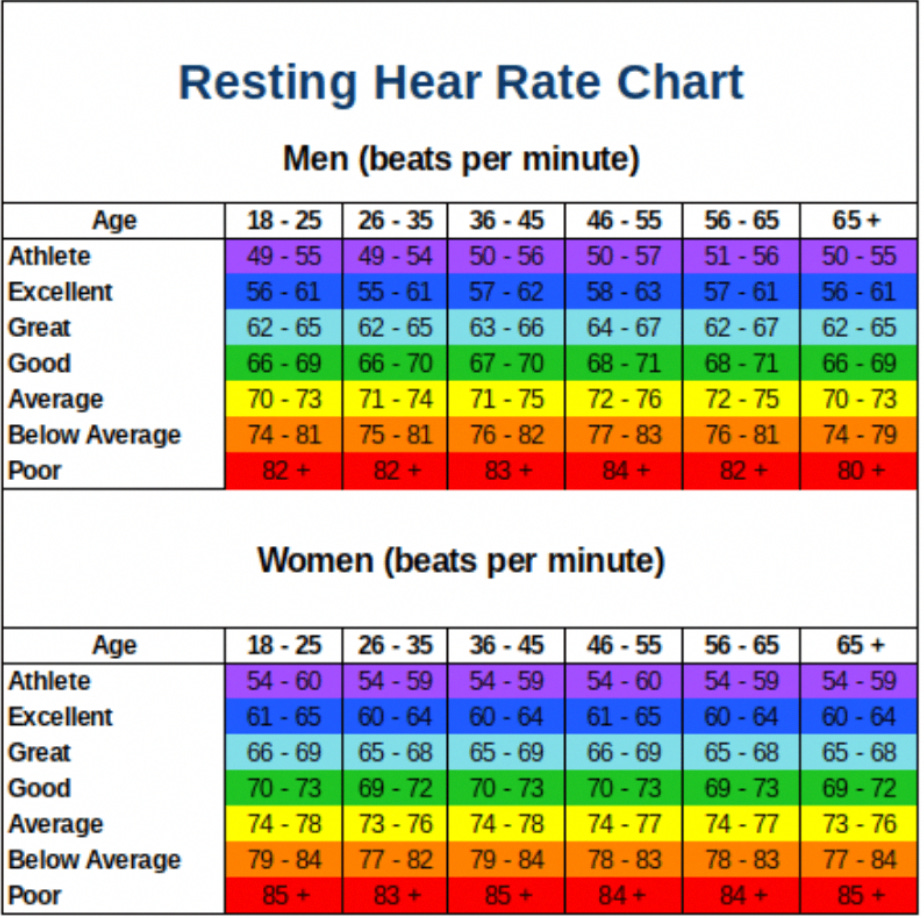
Wise advice, however, there are health metrics that can be measured and do matter. The first I would like to talk about is resting heart rate (RHR).
Resting heart rate (RHR) is a good proxy for cardiovascular conditioning. The best measure of cardiovascular fitness is the VO2 Max test. VO2 Max is the total amount of oxygen you can take in during maximum exertion. The more oxygen you can take in the more endurance you have. There are many other factors to being a good endurance athlete but VO2 Max is an important component. An elite cyclist for example will typically be over 70 and often over 90. Alaskan Husky sled dogs have values above 200.[1]
The most accurate way to measure VO2 Max is in a lab on a treadmill or stationary bike with a mask on your face to determine the amount of oxygen you take in during a maximum effort. There is a much easier way to get an estimate though, measure your resting heart rate (RHR.)
To find your RHR take your heart rate first thing in the Morning before getting up. You can do this with a smart phone app, a blood pressure monitor or pulse oximeter. Or you can count how many times your heart beats in 20 seconds by checking your pulse on your wrist, neck, or temple and multiply by three to get your beats per minute.
You can enter in your age and beats per 20 seconds at OmniCalculator.com to get an estimated VO2 Max. Other, more involved, and perhaps more accurate ways are the Rockford Walk Test and the YMCA Step test.
I have done all three and my VO2 Max scores were 52, 48, and 63, which indicates, at least in my case, the RHR method is a relatively good estimate.
Cardiovascular fitness is important even if you have no desire to compete in sporting events. Cardiovascular fitness is important if you want to live your best life.
A study of Swedish women found that those women with high physical fitness in middle age were 90% less likely to get Alzheimer’s Disease (AD) and those that did get AD, contracted the disease a full decade later.[2]
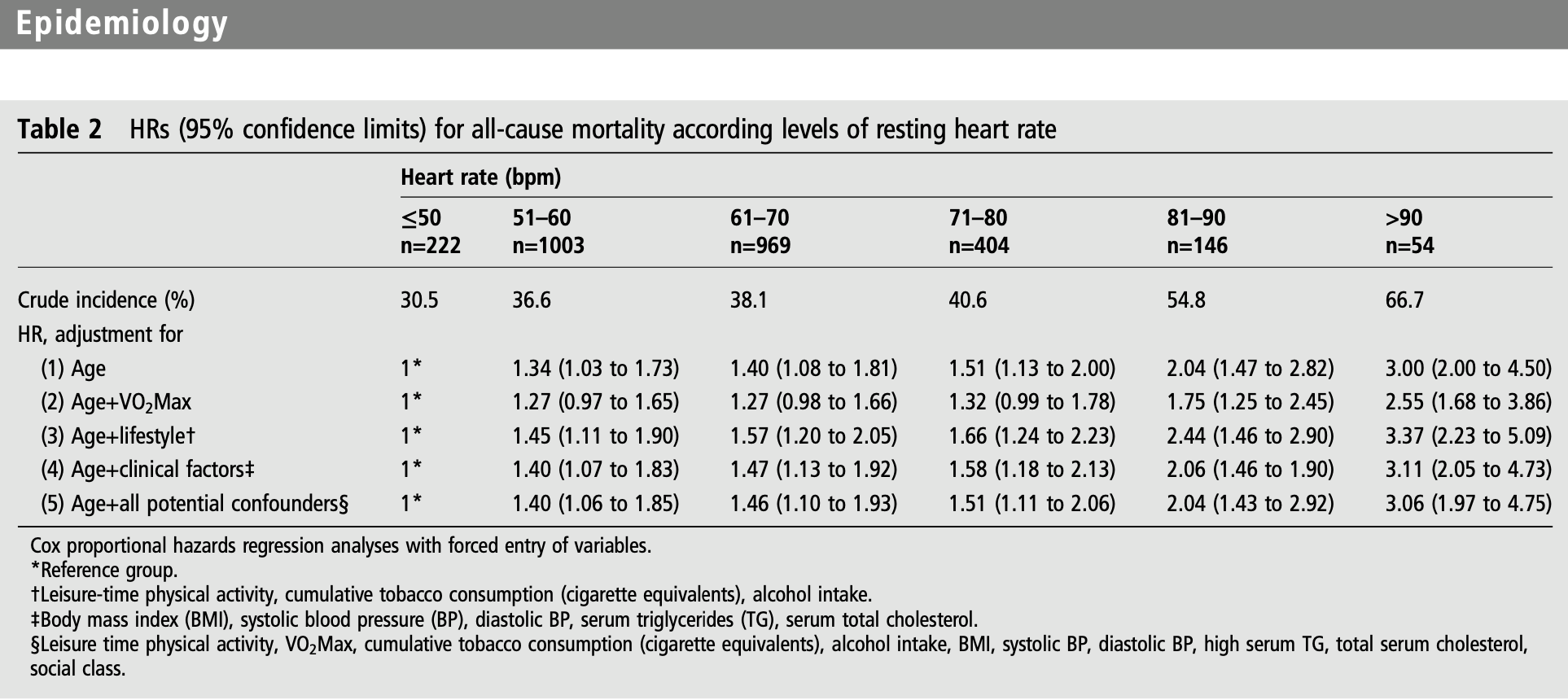
A study of Danish men found a low resting heart rate conferred longevity benefits over and above it being a marker for good cardiovascular fitness.
“These results suggest that in healthy subjects, elevated resting heart rate is not merely a marker of poor general fitness but an independent risk factor.”
The lowest death rate was found with an RHR below 50 beats per minute (bpm). Those with an RHR in the 50s had about a 40% greater risk of dying, those with an RHR between 61 – 80 about 50% greater risk, above 80 were twice as likely to die in a given time frame and those above 90 had a 3 times greater risk of dying.[3]
Another study found that those with a RHR over 75 were twice as likely to die.[4]
Taking your resting heart rate each Morning is a good habit to develop. An elevated RHR over your normal reading can indicate you are over stressed. It could mean you have been training too hard or not getting enough restful sleep (physical stress) or a sign of mental or emotional stress.[5]
It is always a good idea to be sensitive to and pay attention to your body’s signals. The one thing that has been shown to decrease your resting heart rate and thus increase your lifespan and health span is exercise.
As with planting a tree, the best time start an exercise program was 20 years ago. The second-best time is today.
Everyone knows the key to living healthy is "eat right and exercise". So why is losing weight or getting in better shape on your own so hard?
With so much conflicting advice it's almost impossible to figure out what actually works. Not to mention, eating bland food and exhausting workouts does not sound like fun.
Grand Strand Health Coaching provides custom plans for your exact situation, no matter what your age or current physical condition.
Getting started is quick and easy.
1. Take a quick questionnaire - assess your current health and determine your goals
2. Get a custom plan - Get results with Motivation, Information and Accountability built into every session
3. Start looking and feeling better - small changes over time get big results
Schedule your free consultation at: www.DaveBeruh.com or Text: 610-235-7567 or email: DaveBeruh@GMail.com
[1] https://en.wikipedia.org/wiki/VO2_max
[2] https://www.sciencedaily.com/releases/2018/03/180315101805.htm
[3] https://heart.bmj.com/content/heartjnl/99/12/882.full.pdf?with-ds=yes
[4] https://www.sciencedaily.com/releases/2019/04/190415200241.htm
[5] https://blog.fitbit.com/resting-heart-rate/