
Anabolic Resistance
Why Building Muscle Gets Harder With Age

David Beruh is certified as an ACE Health Coach and NASM Personal Trainer. This newsletter is for educational purposes. It is not a substitute for professional medical advice. Consult your healthcare provider to determine the suitability of this information or with questions about a medical condition, treatment, or lifestyle change.
Why Building Muscle Gets Harder With Age (And What You Can Do About It)
If you have ever felt like you are working just as hard in the gym as you did ten years ago but getting less out of it, you are not imagining things. There is a real biological reason why building and keeping muscle becomes more difficult as we get older. It is called anabolic resistance, and understanding it could change how you train, how you eat, and how you age.
What Is Anabolic Resistance?
Your body is constantly breaking down and rebuilding muscle. This process of rebuilding is called muscle protein synthesis (MPS), and it is happening all the time. When you lift weights or eat protein, your body gets a signal to build more muscle. In a healthy young adult, the system works beautifully. Eat some protein, do some exercise, and your muscles respond by getting bigger and stronger.
Anabolic resistance is what happens when that system starts to break down. Your muscles stop responding as strongly to the signals that used to work. Think of it like a smoke detector with a weak battery. The alarm still goes off, but not as loudly, and not as reliably. The trigger is the same, but the response is weaker.
This blunted response is a key driver of the muscle loss we see as people age, a condition known as sarcopenia. And the consequences are serious. Less muscle means weaker bones, a higher risk of falls, slower metabolism, and a harder time recovering from illness or injury.
In addition muscle is the main way body stores excess sugar. When you eat more than you burn the body converts the excess carbs (and protein) into glycogen to be stored in your muscles. When your muscles are full the body converts those calories into more fat tissue.
So more muscle, allows you to eat more without gaining fat. It also decreases insulin resistance a key driver in Metabolic Syndrome and chronic diseases.
Why Does This Happen as We Age?
Several things go wrong at the same time, and they all feed into each other.
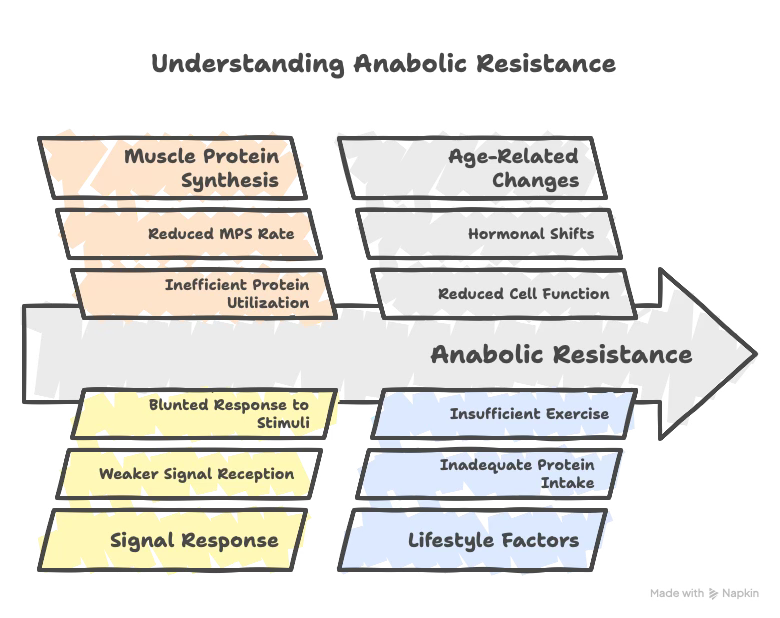
First, the body’s internal communication system slows down. There is a pathway inside your muscle cells responsible for turning protein into new muscle tissue. With age, this pathway becomes less responsive. It takes a bigger push to get the same reaction.
Second, your body becomes less efficient at delivering amino acids (the building blocks from protein) directly to your muscles. After you eat a protein-rich meal, younger bodies shuttle those building blocks quickly into muscle tissue. In older adults, more of those amino acids get used up by the gut and organs before they ever reach the muscles.
Third, hormone levels drop. Testosterone and growth hormone both play important roles in helping muscles grow. Both decline with age, which makes the whole system less responsive from the start. And this is as true for women as men.
Fourth, muscle cells in older adults have fewer ribosomes, which are the tiny structures inside cells that actually do the work of building new proteins. Older adults have both fewer of these structures and reduced ability to use the ones they have. Less building capacity means less muscle growth, even when the raw materials are available.
The result of all this is that older adults need significantly more stimulation to get the same muscle-building response that younger people get easily. Research shows that while a younger person might need about 0.24 grams of protein per kilogram of body weight at a single meal to fully trigger muscle building, an older adult needs roughly 0.40 grams per kilogram at that same meal to achieve a comparable response.
If your ideal weight is 150 pounds that means a meal with 16 grams of protein but as you get older that number increases to 27 grams. Of course this is just a broad estimation but as a general rule of thumb it is a good idea to get 30 grams of protein per meal, especially for breakfast and lunch.
Who Is Most at Risk?
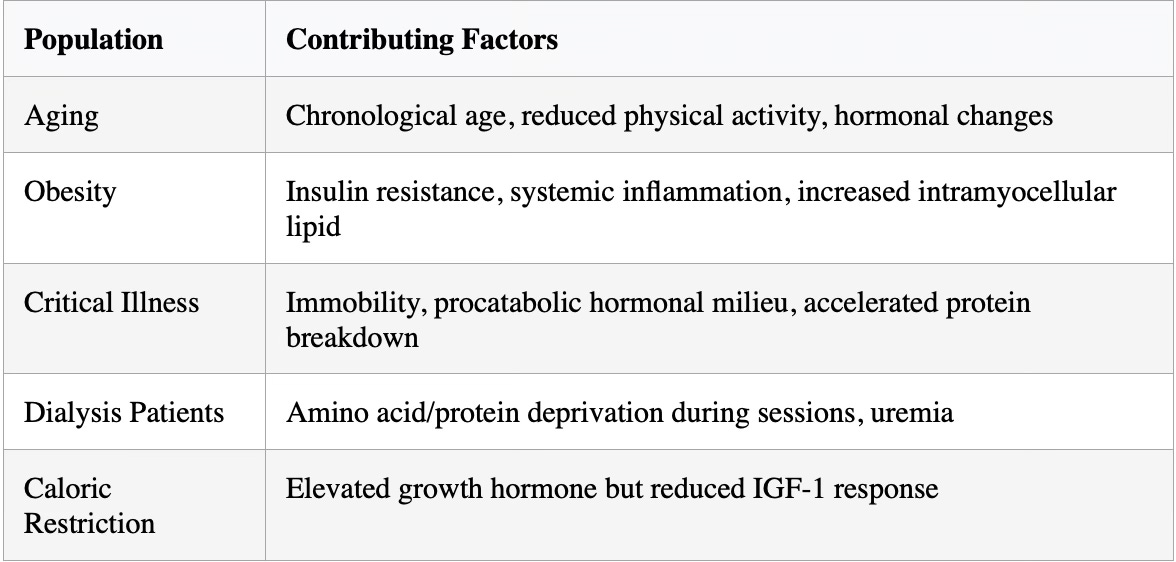
While aging is the most common cause, anabolic resistance is not limited to older adults. Research has found that it can affect people who are significantly overweight, people who are sedentary, individuals with chronic illness, people in critical care settings, and anyone going through long periods of very low calorie eating.
This matters because it means anabolic resistance is not just an “old person problem.” It is a condition that can develop or worsen at any age depending on how you live.
What Can You Do About It?
Here is the good news: anabolic resistance is not a life sentence. Research published in Nutrition Reviews makes the case that while some degree of this change may come with aging, much of it is preventable and even reversible with the right habits. Two things, used together, are the most powerful tools available.
Strength training is the single most important intervention. Lifting weights directly wakes up the muscle-building pathways that have gone quiet. The effect lasts 24 to 48 hours after each session, which is why consistency matters so much. Research supports training that uses multiple muscle groups, moderate to heavy weights, and enough total sets and reps to really challenge the body.
Protein intake needs to go up, not stay the same. The US government guidelines just increased recommended protein intake to 1.2 to 1.6 grams per kilogram per day. Which works out to about two-thirds to three-quarters grams of protein per pound of ideal body weight. So again for a 150 pound adult that works out to a minimum of 100 grams of protein a day.
Just as important as the total amount is how you spread it out. Eating 0.4 grams per kilogram at each meal, rather than loading most of your protein into one or two meals, helps keep the muscle-building signal switched on throughout the day.
The type of protein also matters. As a general rule animals sources are of higher quality. Vegetarians should shoot for about 20% more protein than the recommended amount.
When you combine consistent strength training with optimized protein intake, studies show that the gap between older and younger adults in terms of muscle-building ability can be dramatically reduced and in some cases eliminated entirely.
Start Where You Are
You do not need to be a competitive athlete or follow a complicated program to fight back against anabolic resistance. Start by adding two to three strength training sessions per week. Focus on compound movements that work multiple muscle groups at once, like squats, rows, and pressing movements. Make sure you are getting enough protein at every meal, not just after the gym.
If you are in your 40s or 50s, the science is especially clear: the habits you build now will shape how strong and independent you are in your 70s and beyond. Anabolic resistance is a real challenge, but it is one that responds well to consistent effort, smart nutrition, and a little understanding of what your body actually needs.
Your muscles are not done growing. They just need a bigger invitation.
One final word for men: If you haven’t lifted weights since you were younger, start slow. Your biggest obstacle to progress is injury. Weight lifting is extremely safe unless you overdo it. Healing from a lifting injury take a lot more time in your 50s and beyond than it did in your 20s.
One final word for women: If you have never lifted before, now is the time to start. Unlike men, my experience has been many women don’t lift heavy enough. If you have never lifted weights before investing in a personal trainer at least to start is a great choice. Like the men you can start with light weights. But once you can do 15 repetitions of an exercise it’s time to increase the resistance.